Subscribe in the Lingeva iOS or Android app. Your store shows final prices, trial eligibility and renewal terms.
How can you practise speaking German without a partner?
Choose one small situation, prepare a few useful phrases, then say your own response aloud without reading it. Change one detail and try again. You can rehearse both sides yourself or use an AI conversation in the app when you have access. Solo practice gives you a place to prepare; it does not reproduce every interruption, accent or unexpected reply in a conversation with another person.
Try a ten-minute practice session
This is a suggested starting routine, not a tested formula or a promise of fluency. Take longer, repeat a step or stop when you need to.
Minutes 1–2: choose your task
Use a situation you may actually encounter: introducing yourself to a neighbour, asking for a price or arranging a meeting. Decide what you need to communicate. Write three useful phrases, not a speech to memorise.
Minutes 3–5: say a first version
Read the short example below, then look away and introduce yourself aloud. Use a made-up name if you prefer. Pause or simplify your sentence when you get stuck; you do not need to finish a perfect script.
Minutes 6–8: change the conversation
Change the name or situation. Ask for repetition, or give a different answer. Rehearse the reply as well as your opening line. If you use an AI partner, check any unfamiliar correction before treating it as a rule.
Minutes 9–10: choose one thing to revisit
Note one phrase you could not retrieve or one sound you want help with. Say the exchange again with that focus. A teacher or proficient speaker can help when you are unsure what needs changing.
An original example: meeting a neighbour
The people and exchange below are fictional practice material. Read each German line, check its meaning, then cover the text and answer in your own words.
You:Guten Tag, ich bin Minh. Ich wohne seit Kurzem hier. Wie heißen Sie?
Hello, I am Minh. I have recently moved here. What is your name?
Neighbour:Guten Tag! Ich heiße Keller. Herzlich willkommen.
Hello! My name is Keller. Welcome.
You:Könnten Sie das bitte wiederholen?
Could you please repeat that?
Neighbour:Natürlich. Ich heiße Keller.
Of course. My name is Keller.
You:Danke, Frau Keller. Auf Wiedersehen!
Thank you, Ms Keller. Goodbye!
Connect the phrase to the grammar
This example uses the polite form Sie. Compare the two questions below. Use one form consistently in the exercise; in a real conversation, follow the form of address you have agreed on.
When you have an opportunity, use one prepared phrase with a person who is willing to talk. Listen to their reply rather than trying to finish your script. You can ask them to repeat or speak more slowly. Afterwards, note what surprised you and use that as your next practice task.
What AI rehearsal can—and cannot—tell you
Typing a reply lets you rehearse wording, but it is not oral practice and does not show how you pronounce it. Speaking aloud adds a different task. AI responses and corrections can be mistaken; a transcription is not a complete pronunciation assessment. Feedback is not a language certificate or an official exam result. Ask a qualified teacher about persistent difficulties or exam requirements.
Using Lingeva for the next attempt
This written exercise needs no account or microphone. In Lingeva, AI Speaking requires Premium or eligible trial access, subject to usage limits. Recording takes place in the app after the relevant permission, not on this public page. The app interface and explanations are available in English and Vietnamese; German is the language you practise. Check your current access and available controls in the app.
Clarify a Detail and Keep the German Conversation Going
A useful speaking routine also needs a way to handle an answer you did not expect. Practise asking for one detail, checking what you heard and replying to the new information.
Ask for repetition or a slower explanation
If you missed the time, ask about the time. If the whole sentence was too fast, ask for a slower repeat. The following exchange is fictional and uses the polite Sie form.
A clarification that leads to an answer
Speaker
German line
Meaning
Other person
Wir treffen uns am Donnerstag um vierzehn Uhr.
We are meeting on Thursday at 14:00.
You
Könnten Sie die Uhrzeit bitte noch einmal langsam sagen?
Could you say the time again slowly?
Other person
Um vierzehn Uhr, also um zwei Uhr nachmittags.
At 14:00, that is two in the afternoon.
You
Danke. Also Donnerstag um zwei Uhr nachmittags.
Thank you. So Thursday at two in the afternoon.
Keep the request specific when you can. Another useful question is: Was bedeutet das Wort? Use it when the problem is meaning rather than speed.
Lingeva app example
Choose a manageable conversation setup
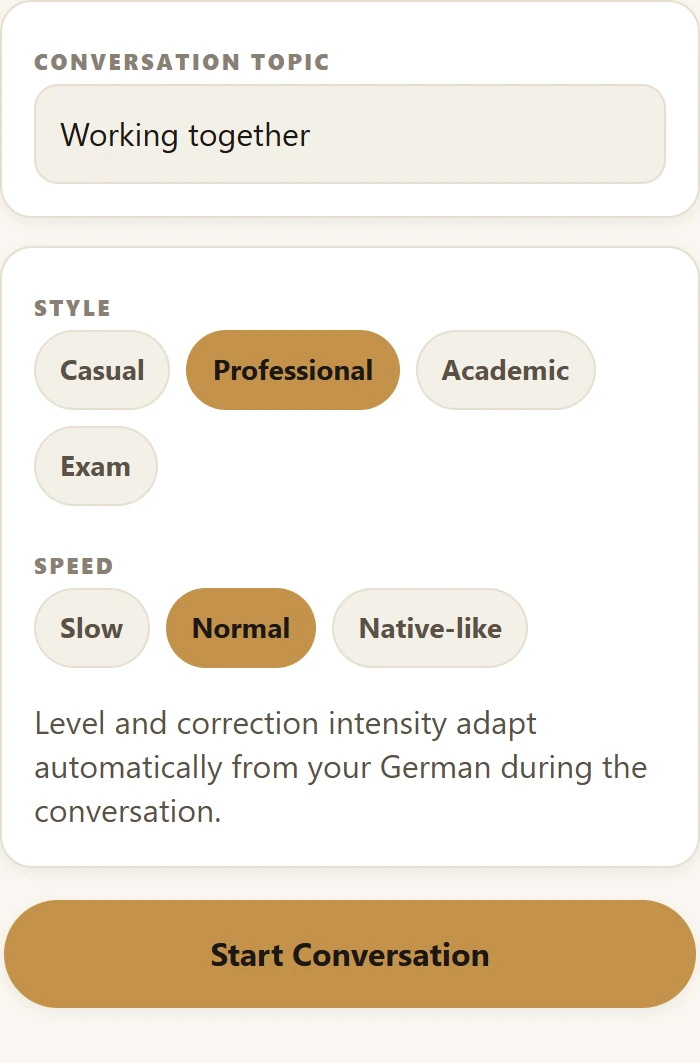
This example shows a work-related topic with style and speed controls. A slower setting can give you a manageable starting point; still practise asking for repetition when you miss something. AI conversation requires Premium or an eligible trial, with permissions and usage limits.
English app interface.
Captured 23 September 2026; the interface may change.
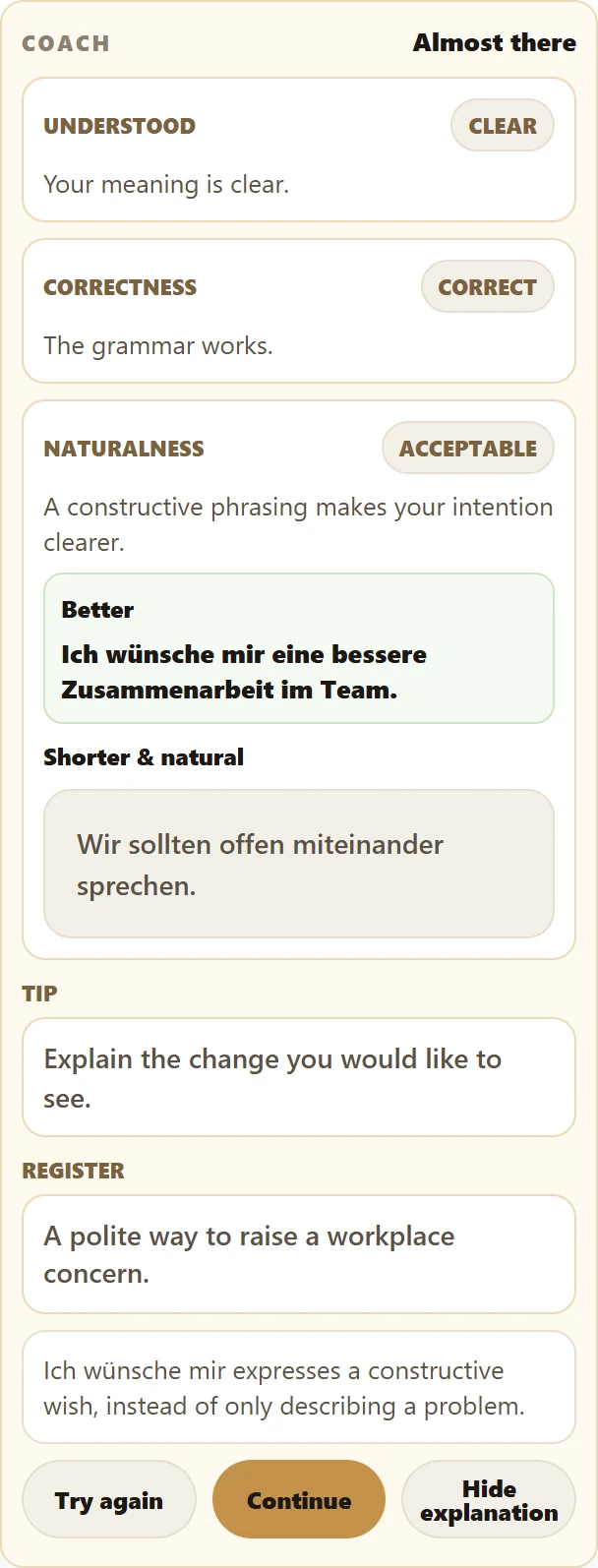
The prepared example separates whether the message is understood from grammar and naturalness. Choose one suggestion, try the sentence again, then continue the conversation. The displayed feedback is demonstration data, not a measured learner result.
English app interface.
Captured 23 September 2026; the interface may change.
The app lets you choose a partner, a topic, the conversation style and playback speed. Use voice or typed replies. You control the start; microphone and AI-sharing permission are requested before the relevant transfer.
Work with your own answer
Review grammar, naturalness and register. Alternative wording appears when it is useful, rather than on every answer. Where a recognised grammar topic is linked, open a drill to practise it. An advanced scenario can support a discussion without a separate discussion product.
Watch the app walkthrough
Silent demo · prepared example responses
A short recording of the actual English app with isolated demo data. The opening and feedback are prepared test responses. No live AI, real customer, voice recording or purchase is involved. Silent video; translated captions and transcript are available.
Transcript
Demonstration with prepared responses in the actual English Lingeva interface. The conversation partner is Lena Hoffmann. The topic is changed to “Working together”; Professional style and Slow speed are selected. Start Conversation opens a prepared German greeting. The demo learner types: “Ich finde, die Stimmung im Team ist nicht gut.” Check answer displays prepared feedback that separates understandability, grammatical correctness and naturalness. The suggested wording is: “Ich wünsche mir eine bessere Zusammenarbeit im Team.” A shorter alternative is: “Wir sollten offen miteinander sprechen.” Explain opens the prepared note: “Ich wünsche mir expresses a constructive wish, instead of only describing a problem.” This recording demonstrates actual controls and rendering, not the quality of live AI or a real learner’s proficiency.
AI Speaking is a Premium feature in the app. Permission and usage limits apply. This website does not start a live AI session.