Learn German vocabulary with articles, plurals and example sentences. Try a recall-and-use exercise, then explore vocabulary practice in Lingeva.
How do you turn German vocabulary into words you can use?
Learn a word together with a useful sentence, then try to retrieve it without looking. For a noun, keep its article and plural with it. Finally, change the example to say something you need. Recognising a translation and producing a word in conversation are different tasks; this exercise lets you practise the second one.
A short recall-and-use routine
Choose three words from one situation, rather than an unrelated long list.
Read each word with its article, plural and example. Check the meaning before covering the text.
Use the situation as your cue: say the phrase aloud without looking, then check it.
Change one detail, such as the day or the person. Revisit difficult items in a later session.
Worked example: arranging an appointment
These sentences are original written practice examples. They are not an extract from a learner conversation or a claim that every item appears in the app.
Worked example: arranging an appointment
Word and plural
Meaning
Example
der Termin · die Termine
appointment
Ich habe morgen einen Termin.
die Frage · die Fragen
question
Ich habe eine Frage.
die Antwort · die Antworten
answer
Danke für Ihre Antwort.
Cover the table. How would you say that you have an appointment tomorrow? Try your answer before opening the example.
Show one possible answer
Ich habe morgen einen Termin.
The noun keeps its masculine gender, but after habe the indefinite article is einen in the accusative. Now replace morgen with am Freitag. This tests a small change, not just repetition of the whole sentence.
What should you review next?
If you remember the meaning but not the article, review the noun phrase. If you can read the sentence but cannot say it unaided, practise recalling the phrase. If the sentence is clear but one sound is difficult, take that word into pronunciation practice. This is a way to choose your next task, not a diagnosis of your level.
Two common vocabulary questions
Do I need to learn every meaning at once?
Start with the meaning you need in the chosen situation. Add another meaning with a separate example when you meet it. Do not assume that one translation fits every context.
How often should I review?
Return to words across later sessions and give more attention to items you cannot retrieve. There is no single schedule here that guarantees retention. Adjust the amount to what you can review and use.
Continue with Lingeva’s vocabulary practice
The existing public word task below lets you try a small sample. In the app, word details and review activities vary by item and level. Free core learning covers A1–B1; B2–C1 content requires the relevant Premium access. The app interface and explanations are in English and Vietnamese, but some vocabulary explanations may fall back to English. Check current access in the app.
To use a German word in a conversation, learn a small word combination as well as its meaning. Keep the preposition and case with the verb, then use the combination to answer a new cue.
Two useful verb–preposition combinations
Original appointment-related examples
Pattern
German example
Meaning
warten auf + Akkusativ
Ich warte auf den Termin.
I am waiting for the appointment.
fragen nach + Dativ
Ich frage nach dem Termin.
I am asking about the appointment.
Termin is masculine: der Termin. In these examples it becomes den Termin after auf in warten auf, but dem Termin after nach in fragen nach. These are the cases used by these combinations; they are not a rule that every use of auf takes the accusative.
Give each card a purpose: “I am waiting for…” or “I am asking about…”. Say the whole phrase before checking it. These are public practice examples. The vocabulary available in the app can differ.
Lingeva app example
Keep the phrase with the noun
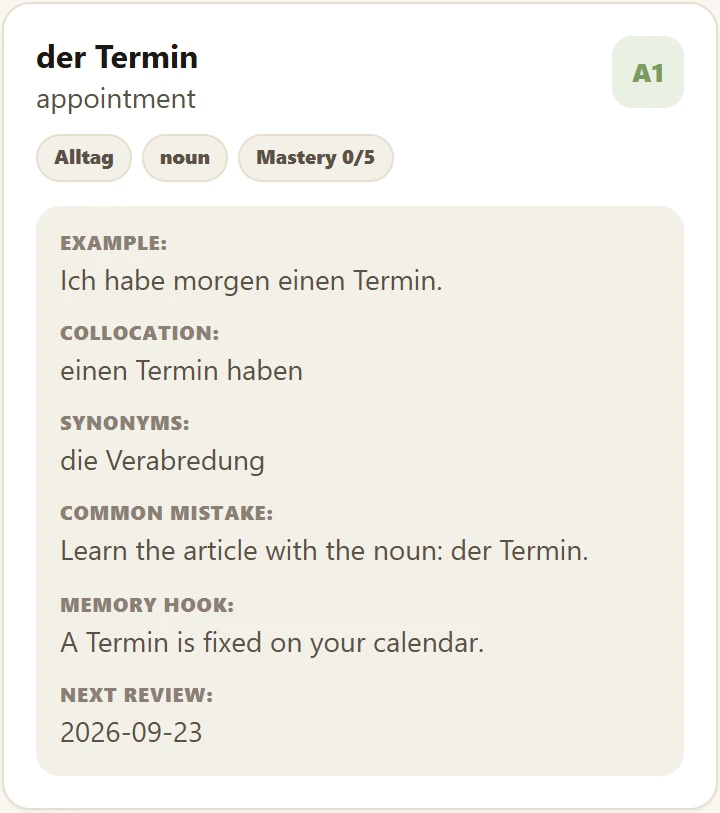
The card shows der Termin and einen Termin haben together. Keep a verb–preposition combination together in the same way: warten auf einen Termin. Termin and Verabredung are not interchangeable in every context; choose the word for the situation.
English app interface.
Captured 23 September 2026; the interface may change.
You are waiting for the documents, not the appointment. Use: die Unterlagen.
Show one possible answer
Ich warte auf die Unterlagen.
Warten auf uses the accusative here. Die Unterlagen is plural.
Now ask about the documents. Use fragen nach.
Show one possible answer
Ich frage nach den Unterlagen.
Nach takes the dative in this combination: den Unterlagen. The noun already ends in -n, so no additional -n is needed.
Cover the answers and give the two messages in a different order. Check whether you chose the intended verb as well as the case. Being able to recite a list of endings is not the same task as making a request.
For a noun, keep its article with the word. Read the German example alongside its translation. Flashcard meanings and example translations follow your English or Vietnamese app language where available; missing Vietnamese text falls back to English. Example labels identify the language shown. Additional details vary by entry.
Recall it, use it, revisit it
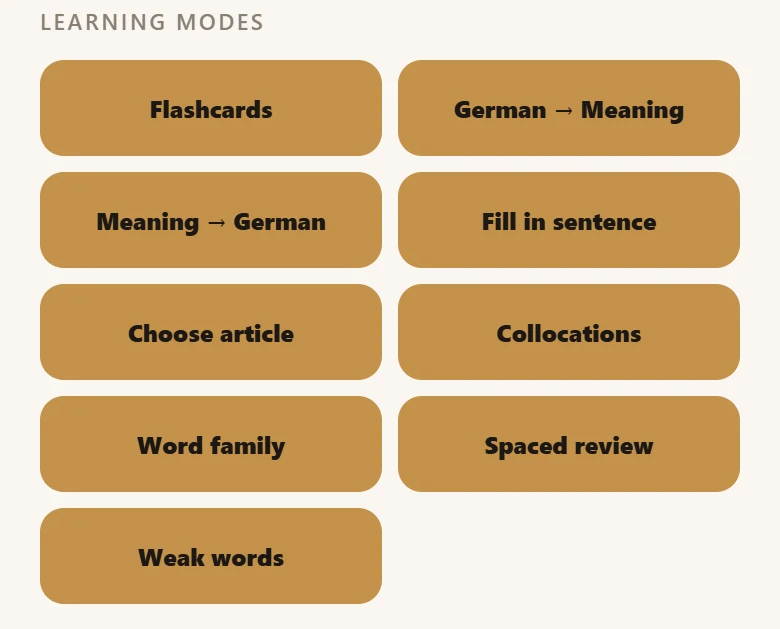
Vocabulary practice includes recall, article and gap tasks. Review can bring back due words and weak items from your activity. The small sample here is an illustration and does not add words or results to an account.
A1
der Apfel
A round fruit with a core.
Plural: die Äpfel
Ich esse jeden Tag einen Apfel.
I eat an apple every day.
Der Apfel ist rot und süß.
The apple is red and sweet.
One word, several ways to remember it
Explore a verified word entry, then try recall, article and gap practice. This sample does not change any vocabulary list or learning progress.
Type the German word for apple. Include the article if you remember it.
Show the answer
der Apfel · einen Apfel
Der Apfel — remember the article and noun together. The plural is die Äpfel.
Vocabulary practice
English app interface
Complete vocabulary-mode selector; larger image shows the actual catalog filtered to Apfel.