
Notice what changes
Compare Wie heißen Sie? with Wie heißt du? The person and the verb change together. Looking at both forms makes the formal question easier to understand than memorising an ending alone.
Home / German Grammar Practice: Use the Rule in a Reply
Practise German word order with statements, questions and short reasons. Original examples show how to use a grammar pattern in an everyday reply.
To use German grammar while speaking, choose one sentence pattern, connect it to a message and change a detail. Say the new reply before checking the example. The exercises here focus on short statements, polite questions and a reason with weil; they are a starting point, not the whole grammar system.
Imagine you are arranging a language-course appointment. You need to say when you are available, ask about another time and explain a conflict. Use the table to compare three ways of doing that. These are original examples.
| Message | German example | What to notice |
|---|---|---|
| Say when you work. | Am Dienstag arbeite ich. | In this statement, arbeite is in the second position. Am Dienstag occupies the first position as one unit. |
| Ask whether another day is possible. | Kann ich am Mittwoch kommen? | Kann starts this yes/no question; the infinitive kommen is at the end. |
| Ask for a time. | Wann kann ich kommen? | The question word Wann comes first, followed by kann; kommen is at the end. |
Position means a part of the sentence, not necessarily one written word. Am Dienstag has two words but fills one position in the example. Start with short sentences so you can hear what changes.
Lingeva app example
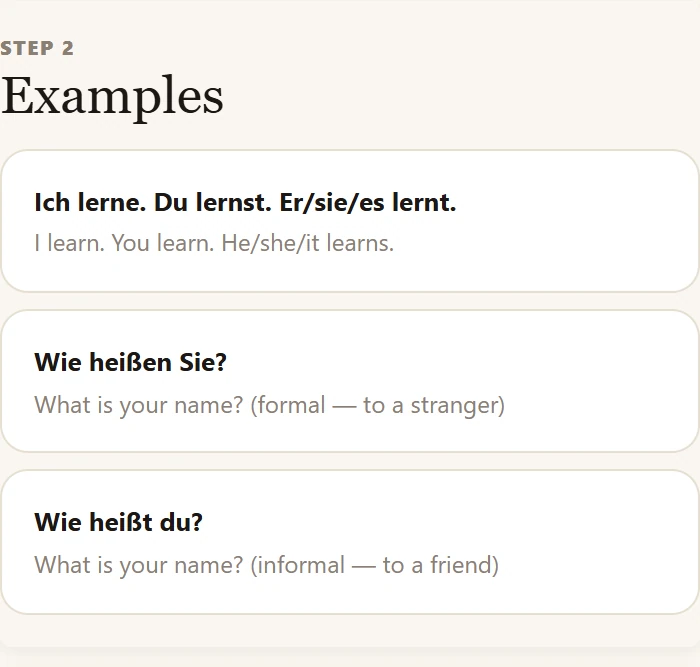
Compare complete examples before changing the pattern
The statement Ich lerne and the question Wie heißen Sie? show grammar doing a job in a complete message. Compare the verb forms and positions, then make your own statement or question with the patterns in this lesson.
English app interface.
Captured 23 September 2026; the interface may change.
Open the screenshot at full sizeRead the cue, cover the answer and say a complete reply. The goal is to make the new information clear.
You can come on Thursday. Answer: Wann können Sie kommen?
Am Donnerstag kann ich kommen.
Am Donnerstag is the first unit; kann stays in the second position of this statement and kommen remains at the end.
You want to ask whether you may come on Friday. Use a polite question.
Kann ich am Freitag kommen?
The yes/no question begins with Kann. In this sentence, ich is the subject; addressing someone politely does not mean every verb takes the Sie form.
Now change Thursday to tomorrow morning and say your own answer. One option is: Morgen Vormittag kann ich kommen. Afterwards, look for one word-order point to check.
For the standard written pattern used here, place the conjugated verb at the end of the weil-clause. Start from the two separate ideas, then join them. This exercise covers simple clauses, not every possible verb combination.
Am Dienstag kann ich nicht kommen. Ich arbeite bis acht Uhr.
Am Dienstag kann ich nicht kommen, weil ich bis acht Uhr arbeite.
Explain that you cannot come on Monday because your course starts at nine. Use: Mein Kurs beginnt um neun Uhr.
Am Montag kann ich nicht kommen, weil mein Kurs um neun Uhr beginnt.
The reason is introduced by weil; beginnt is at the end of that clause. In natural spoken German, you may also hear other weil constructions. Here you practise the standard subordinate-clause pattern.
Keep your reason short. If you lose the sentence while speaking, two clear sentences are a useful starting point. Then practise combining them again.
Am Donnerstag haben wir keinen Termin frei. Geht Freitag um zehn?
You can come on Friday, but not before eleven. Answer the actual offer, give one reason and ask for an alternative.
Try a reply with a short reason. You work until eleven.
Freitag passt mir, aber erst ab elf Uhr, weil ich bis elf Uhr arbeite. Haben Sie später einen Termin frei?
This is one possible response. Check the day and time, the weil-clause and the final question. You can also split it into shorter sentences.
For this exercise, choose one focus after you finish the message. If the other person misunderstood the time or request, clarify that meaning first. This is a suggested practice method, not a rule for every lesson.
A short accurate sentence can communicate your purpose clearly. Add a reason or detail when it helps. Sentence length alone does not establish proficiency.
No. Try a new cue and a different situation. A correct answer in one exercise is not a general mastery test.
IDS grammis explains sentence fields, verb position and variation in spoken weil constructions. The dialogue and practice prompts here are original Lingeva examples, not copied exercises or official tests.
Compare Wie heißen Sie? with Wie heißt du? The person and the verb change together. Looking at both forms makes the formal question easier to understand than memorising an ending alone.
Explore pronouns, cases, tense and sentence structure, then more advanced connectors and rhetorical structures. The available practice follows the topic and level; not every explanation has the same number or type of exercises.
Wie heißen Sie?
Sie → heißen
Wie ___ Sie?
Use AI speaking and pronunciation practice, unlock B2–C1 learning, and prepare with Exam Prep A1–C1. Plan allowances apply.
Subscribe in the Lingeva iOS or Android app. Your store shows final prices, trial eligibility and renewal terms.