Home ↗ / German Conversation Scenarios for Everyday Life
German Conversation Scenarios for Everyday Life
Practise a German appointment call with a complete dialogue, English explanations and an unexpected reply. Explore more everyday conversation scenarios in Lingeva.
Practise an everyday German conversation by giving it a clear task: request something, respond to the other person and check the result. In the complete example below, you book a language-course consultation, ask for a different day and confirm the time. Read it first, then cover your lines and try a changed version.
Prepare the purpose of your call
You want to discuss a German course with a language school. Tuesday does not work for you; Wednesday morning does. You need a consultation appointment, not an immediate course booking. The school, staff and caller in this exercise are fictional.
Write down your available days and times.
Have a way to spell your name. Use fictional details while practising.
Prepare one phrase for requesting repetition.
Before finishing, confirm what has actually been agreed.
This is a suggested A2–B1 practice situation, not a level assessment. Use the written version without an account or microphone. It does not book a real appointment.
Lingeva app example
Start with the situation and your role
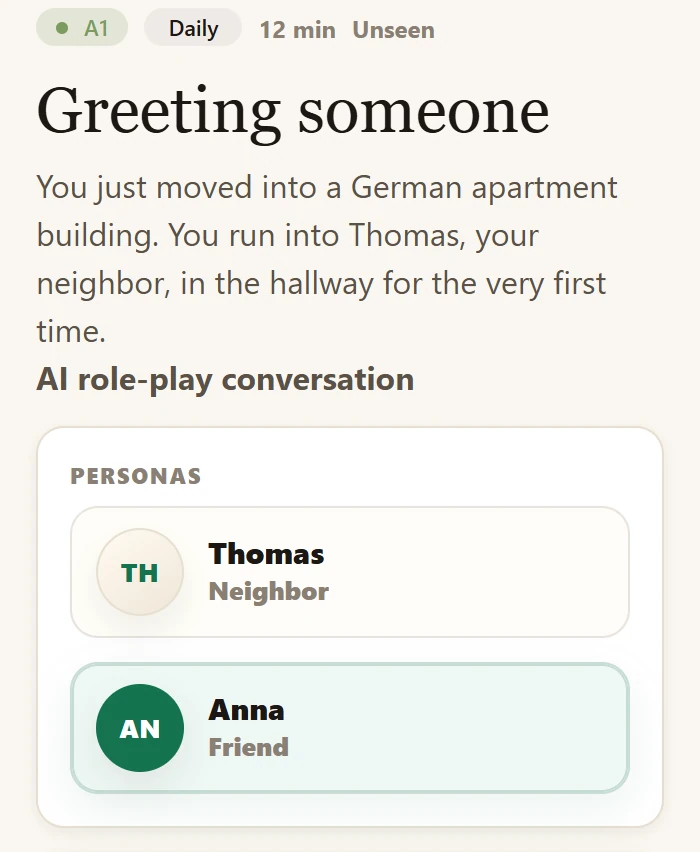
The greeting scenario shows a context and conversation partners before speaking starts. Use the same preparation for the appointment call below: who are you calling, what do you need, and what must you confirm? The screenshot illustrates a greeting scenario, not the appointment dialogue.
English app interface.
Captured 23 September 2026; the interface may change.
The office answers and gives the school and staff name.
Caller
Guten Tag. Mein Name ist Minh Nguyen. Ich möchte einen Beratungstermin für einen Deutschkurs vereinbaren.
You introduce yourself and request a consultation about a German course.
School office
Gern. Haben Sie am Dienstag um vierzehn Uhr Zeit?
The office offers Tuesday at 14:00.
Caller
Am Dienstag kann ich leider nicht. Geht auch Mittwoch?
You decline Tuesday and ask about Wednesday.
School office
Ja, Mittwoch um zehn Uhr ist noch frei.
Wednesday at 10:00 is available.
Caller
Könnten Sie die Uhrzeit bitte noch einmal langsam sagen?
You ask for the time to be repeated slowly.
School office
Um zehn Uhr vormittags.
The office clarifies that it is ten in the morning.
Caller
Also Mittwoch um zehn Uhr. Stimmt das?
You check the day and time together.
School office
Ja. Wie buchstabieren Sie Ihren Vornamen?
The office confirms and asks you to spell your first name.
Caller
M-I-N-H. Minh.
You spell the fictional first name Minh.
School office
Danke, Herr Nguyen. Ihr Termin ist am Mittwoch um zehn Uhr.
The office confirms the appointment.
Caller
Vielen Dank. Auf Wiederhören.
You thank the person and end the phone call.
In this dialogue, the appointment is a consultation. The exchange does not establish course admission, a price or any requirement to bring a document. Ask for those details if they are relevant to your real call.
Keep phrases with the job they do
Useful phrases for a call
Purpose
German phrase
Meaning
Request an appointment.
Ich möchte einen Termin vereinbaren.
I would like to arrange an appointment.
Offer an alternative.
Geht auch Mittwoch?
Would Wednesday also work?
Request slower repetition.
Könnten Sie das bitte noch einmal langsam sagen?
Could you say that again slowly?
Check the outcome.
Also Mittwoch um zehn Uhr. Stimmt das?
So Wednesday at ten. Is that correct?
Ask what to bring.
Was soll ich mitbringen?
What should I bring?
Learn a phrase together with a response you might hear. For example, an alternative day can be accepted or refused. Understanding only your own line is not enough to complete the call.
Lingeva app example
Carry a useful phrase into the call
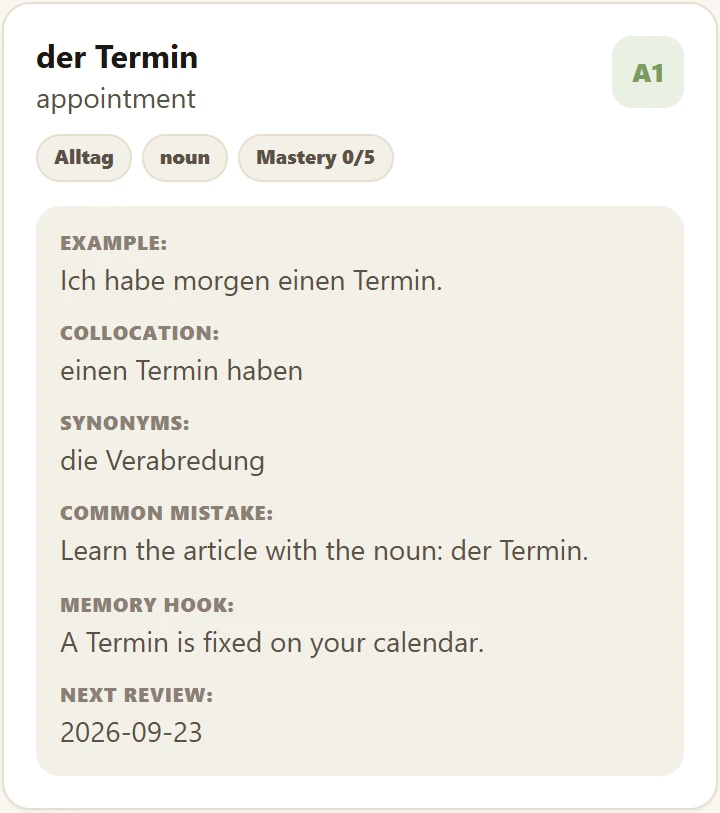
The example Ich habe morgen einen Termin describes an existing appointment. To request one in the dialogue, use Ich möchte einen Termin vereinbaren. Keep the purpose of each phrase clear when you rehearse.
English app interface.
Captured 23 September 2026; the interface may change.
The office says: Mittwoch geht leider nicht. Haben Sie am Freitag Zeit? You can come on Friday only after 15:00. Reply and ask about availability.
Show one possible answer
Am Freitag kann ich ab fünfzehn Uhr. Haben Sie dann einen Termin frei?
Ab means from that time onward. Your answer should not accept a time before 15:00.
The office replies: Ja, um sechzehn Uhr dreißig. Confirm the day and time in one sentence.
Show one possible answer
Also am Freitag um sechzehn Uhr dreißig. Habe ich das richtig verstanden?
You are checking Friday at 16:30. Confirming the complete detail gives the other person a chance to correct it.
You hear a date but cannot understand it. Ask for that detail, not the whole conversation.
Show one possible answer
Könnten Sie das Datum bitte wiederholen?
This is one possible targeted clarification. You can also ask the person to speak more slowly.
Rehearse both sides, then test a new turn
Read the full dialogue and check each turn’s purpose.
Cover the caller’s lines and answer the office aloud. You may use different correct wording.
Change one availability detail and rebuild the call.
With a willing partner, let them choose an unexpected alternative. Alone, draw one changed cue before answering.
Check whether the final day and time match what both people agreed.
A successful practice attempt is one in which the request and agreed details are clear. It is not a real booking or an official speaking score. Do not add a real phone number or personal data to a public exercise.
Some appointment and clarification phrases can transfer, but the questions and purpose will differ. This example is a language-school call and contains no medical advice. Practise the specific information your real situation requires.
Should I memorise every line?
Use the dialogue to understand the task and phrases, then change a detail. The other person in a real conversation may not follow the script.
Can I practise without recording myself?
Yes. Read, cover your reply and say it aloud. Recording is optional; this page does not record or transmit your voice.
Explore another situation
Lingeva connects scenarios with related vocabulary, grammar and exercises. Available activities depend on the scenario and your access. The written example above is independent of app progress; it does not unlock paid AI practice.
Scenario preparation provides context, a task and useful language. Review the phrases and any linked grammar before starting a conversation. A situation can support listening and reading even before you choose to speak.
More than beginner greetings
Intermediate and advanced themes include explaining decisions, workplace discussions and presenting a position. Catalog coverage and the depth of each grammar connection vary. Only the greeting below has been adapted into a complete public lesson here.