Subscribe in the Lingeva iOS or Android app. Your store shows final prices, trial eligibility and renewal terms.
How can you practise German pronunciation on your own?
Listen to a short, reliable spoken example, repeat it and compare one feature at a time. Work on a word first, then put it in a sentence. If you choose to record yourself, listen back before trying again. Written examples can organise your practice, but they cannot replace a spoken model or tell you how your own pronunciation sounds.
Listen, repeat and compare one detail
Choose one short phrase and listen to a reliable reference recording.
Repeat it at a comfortable pace. Focus on one feature, such as the vowel or the stressed word.
If you record yourself, use a quiet setting and listen to the result. Do not judge an attempt from a transcript alone.
Try the same word in a new sentence. Ask a qualified teacher when you cannot hear the difference or are unsure what to change.
A written contrast to take into listening practice
The German verbs bitten and bieten differ in their vowel sounds, including length. Listen to reliable audio for both; the spelling below is a prompt, not an audio demonstration. The second original sentence uses the related verb anbieten: its separable prefix an goes at the end here. The stem bieten keeps the vowel contrast.
A written contrast to take into listening practice
Word
Original example
Meaning
bitten
Wir bitten um Hilfe.
We ask for help.
bieten (anbieten)
Wir bieten Hilfe an.
We offer help.
First listen to and repeat each word. Then use the full sentence. Keep the two meanings separate instead of chasing a single score. This public page does not play a reference recording or record your voice.
Adapt the exercise to the sounds you find difficult
Your first language and learning history may affect what you notice, but not everyone with the same first language has the same difficulty. Select an actual contrast you need help hearing or producing. Aim for understandable speech, not a promise to remove your accent.
What does pronunciation feedback actually mean?
Does a higher AI score prove that my German is better?
No. A score describes an automated estimate for that attempt, not your overall language ability or an official exam result. Read the specific feedback, listen to the recording and consider whether a person can understand the intended message.
Why can feedback change between attempts?
You may have changed your pronunciation, but recording conditions and automated recognition can also affect a result. Compare similar recordings before drawing a conclusion. If feedback remains unclear, ask a qualified teacher rather than treating one score as a diagnosis.
Further practice from the Goethe-Institut
These external resources do not imply an endorsement of Lingeva or a partnership. The examples on this page are Lingeva’s own.
The app provides reference listening, recording controls and pronunciation feedback. Recording requires the relevant permission; automated assessment depends on your access and usage limits. No microphone or paid assessment starts on this public page. Check the current controls and access in the app. The screenshots below show the interface with demonstration data, not a measured learner improvement.
Practise German Final Consonants and Consonant Clusters
For a final consonant or cluster, choose one short recorded word, listen to its ending and then use it in a sentence. Keep the word recognisable without adding an extra syllable. Learners with Vietnamese as a first language can use the checks below, but should choose their own actual difficulty rather than assume everyone needs the same correction.
Listen for the ending inside a useful sentence
A cluster contains neighbouring consonant sounds. The spelling is not a sound-by-sound instruction: in passt, the two written s letters do not call for two separate s sounds. Use reliable audio or a qualified teacher for the spoken model.
Original written prompts for a listening task
Word ending to check
Original sentence
What to compare
kommt · -mt
Der Bus kommt gleich.
Compare the end of kommt with your spoken model. Keep the final t in this careful practice form.
passt · -st
Der Termin passt mir.
Listen to how the final consonants follow each other without an added vowel.
hilft · -lft
Die Frage hilft mir.
Use a slower model if needed, then return to the whole sentence.
The strings -mt, -st and -lft identify a practice focus; they are not complete phonetic transcriptions. The sentences are original written examples. No recording of these exact examples is embedded here.
A focused word-to-sentence exercise
Choose a short reference recording from a reliable resource. If it uses different words, practise those recorded words rather than guessing the sound of ours.
Listen once for the whole word and once for its ending. Notice whether your own attempt loses a consonant or inserts a vowel.
Repeat at a manageable pace. If you cannot hear or produce the contrast, ask a teacher to model it; pushing speed is not the next step.
Put the word into a short sentence, then answer a simple question with that sentence.
If you record yourself on your own device, compare one point and try again. The public page does not request microphone access.
Written transfer prompt: the offered appointment suits you. Use passt in a short reply.
Show one possible answer
Ja, der Termin passt mir.
This checks how you use the word in a reply. The written answer cannot verify your pronunciation; compare your spoken version with a reliable model or human feedback.
A clear practice form can differ from reductions you hear in natural connected speech. Do not try to judge every recording from the spelling alone.
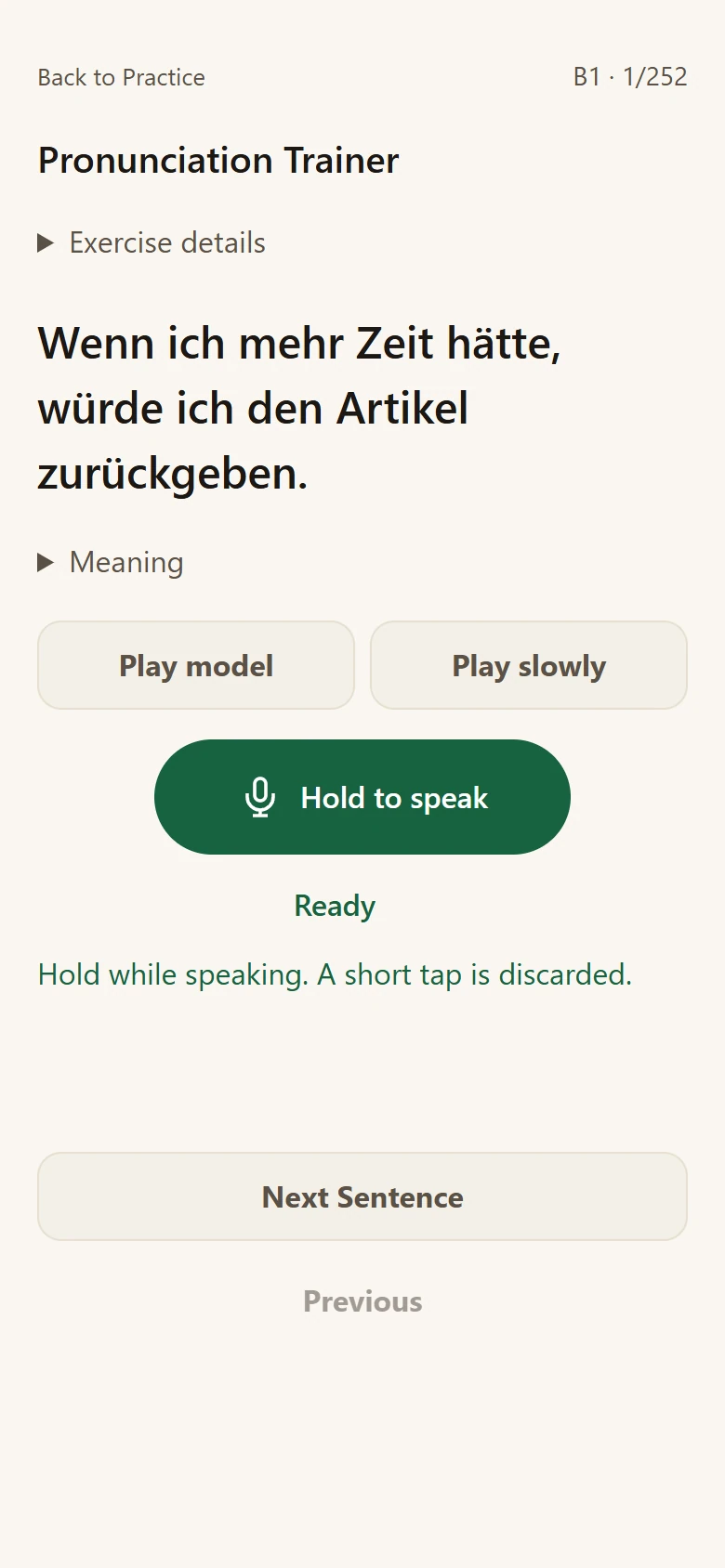
Lingeva app example
Listen first, then record the whole phrase
The model and slow-play controls let you focus on a short stretch before recording. For the final-consonant exercise above, listen for the ending, then record the complete phrase. Recording requires microphone permission; feature access and usage limits apply.
English app interface.
Captured 23 September 2026; the interface may change.
Choose an individual focus as a Vietnamese-speaking learner
Goethe-Institut’s Vietnam teaching resource includes work on word-final consonants and consonant combinations. It is a useful source of listening and teacher-led activities, not proof that all Vietnamese learners make the same errors. Choose one issue that affects your own intelligibility.
Avoid treating a Vietnamese-style respelling as a reliable German sound model.
Ask a listener what word they heard before assuming a score identifies the problem.
Practise a short message you actually need, then check it in another phrase.
For listening practice, open the Goethe materials below and choose a consonant exercise with its recording. This page provides written prompts; the reference recordings are on the external site.
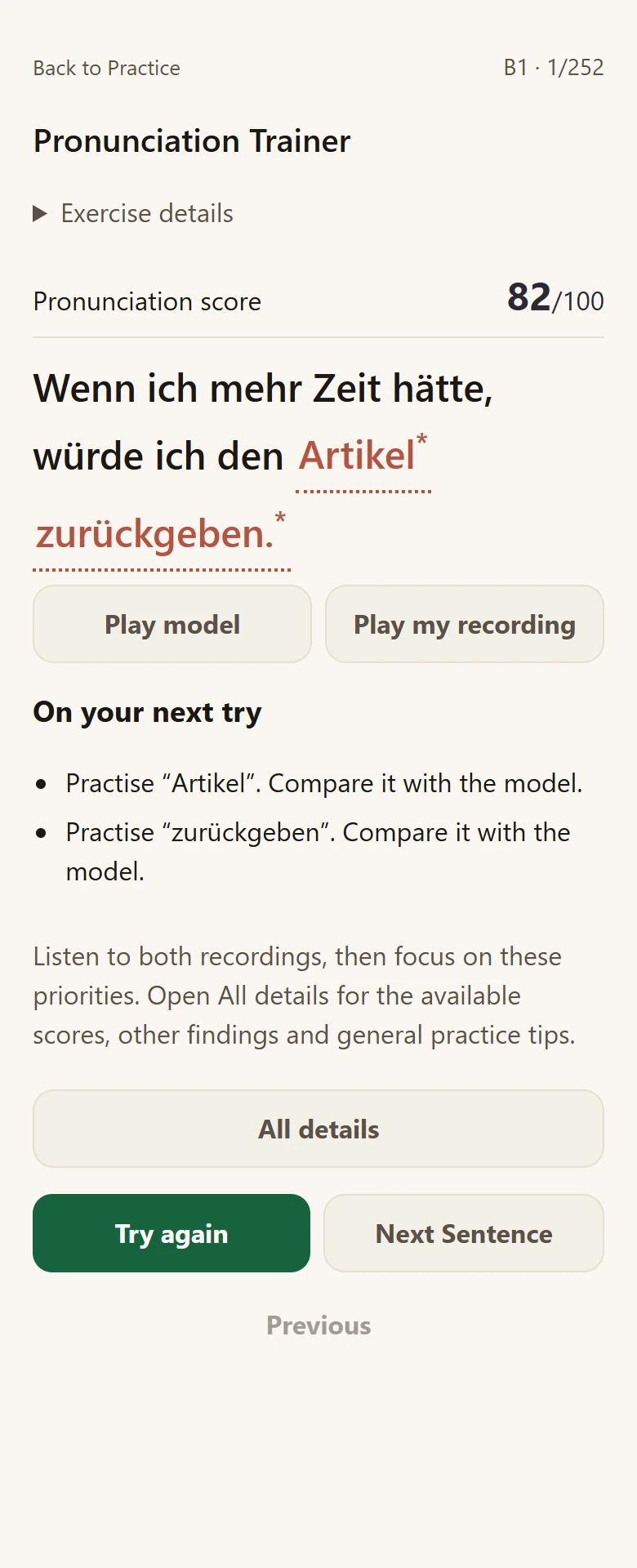
Look at the next-practice suggestion, not only the score
This demonstration highlights individual words and suggests what to try next. Compare your recording with the model and work on one selected point. The shown score is prepared demo data: it does not certify a CEFR level or prove pronunciation accuracy.
English app interface.
Captured 23 September 2026; the interface may change.
Choose Play model or Play slowly when you want to listen. The compact microphone records while you hold it; release to finish. A short tap is discarded. After the assessment, listen to your recording and choose Retry for another attempt. These public website examples never start your microphone.
See the findings. Open the detail you need.
Open the full feedback or a highlighted word to inspect the available findings. Provider assessments, text comparisons and general practice tips are identified separately; missing detail stays unavailable. A transcript alone is not a pronunciation score. Assessment in the app requires the relevant Premium access and permissions. Results are estimates that depend on the recording and supported analysis, not proof of native-level speech.
Listen, hold, review, retry
Guten Tag. Wie heißen Sie?
Open the app to hear reference audio and practise recording after permission. This website currently shows the written example and trainer interface.