
Home / Understand German but Cannot Speak? Practise Your Next Reply
Understand German but Cannot Speak? Practise Your Next Reply
Try three German speaking exercises for retrieving words, building a sentence and handling an unexpected reply. Includes worked examples and a self-review checklist.
Continue your German practice with Premium.
Use AI speaking and pronunciation practice, unlock B2–C1 learning, and prepare with Exam Prep A1–C1. Plan allowances apply.
Subscribe in the Lingeva iOS or Android app. Your store shows final prices, trial eligibility and renewal terms.
If you understand German but struggle to answer, practise producing a small message without the text in front of you. First notice where you get stuck: finding a word, forming a sentence or responding when the conversation changes. Use that observation to choose one exercise below. This is a practice guide, not a diagnosis or a promise of fluency.
What happens when you try to answer?
Reading a sentence with its context and choosing your own words in a conversation are different tasks. Knowing what a sentence means does not show that you can produce it on demand. You do not need to replace all your listening or reading: add a short response task to material you already understand.
| What you notice | Start here | What to check |
|---|---|---|
| The word looks familiar, but you cannot recall it. | Retrieve a phrase from a situation. | Can you say the message before uncovering the example? |
| You find the words but cannot put them together. | Keep one sentence frame and change a detail. | Does the verb still match the subject and the sentence? |
| A prepared answer works until the other person changes the plan. | Practise a changed cue and a clarification question. | Did your answer respond to the new information? |
| You know the sentence but are unsure how it sounds. | Use reliable reference audio and focused pronunciation practice. | Can a listener understand the message? |
This check is informal. Several difficulties can occur together, and it does not assign a CEFR level. Choose a manageable sentence rather than a harder topic just to test yourself.
Exercise 1: retrieve a useful message
Imagine that a colleague suggests meeting tomorrow. You already have an appointment and want to suggest Thursday. Read the example, make sure you understand it, and then cover it.
Morgen habe ich einen Termin. Passt es Ihnen am Donnerstag?
The first sentence explains the obstacle; the second offers another day. The polite Ihnen form fits this example. In a conversation where you use du, the second question becomes: Passt es dir am Donnerstag?
- Look only at the situation, not the German sentence.
- Say the message aloud. If one word is missing, simplify the sentence before checking the example.
- Uncover the example and compare the meaning. A different correct sentence is also acceptable.
- Repeat with a different day and reason, so the task is more than reciting one answer.
New cue: you are busy on Monday, but Tuesday works. Give one short explanation and suggest Tuesday.
Show one possible answer
Am Montag habe ich keine Zeit. Passt es Ihnen am Dienstag?
This is one possible answer. The essential information is the conflict and the alternative; your wording need not match exactly.
Lingeva app example
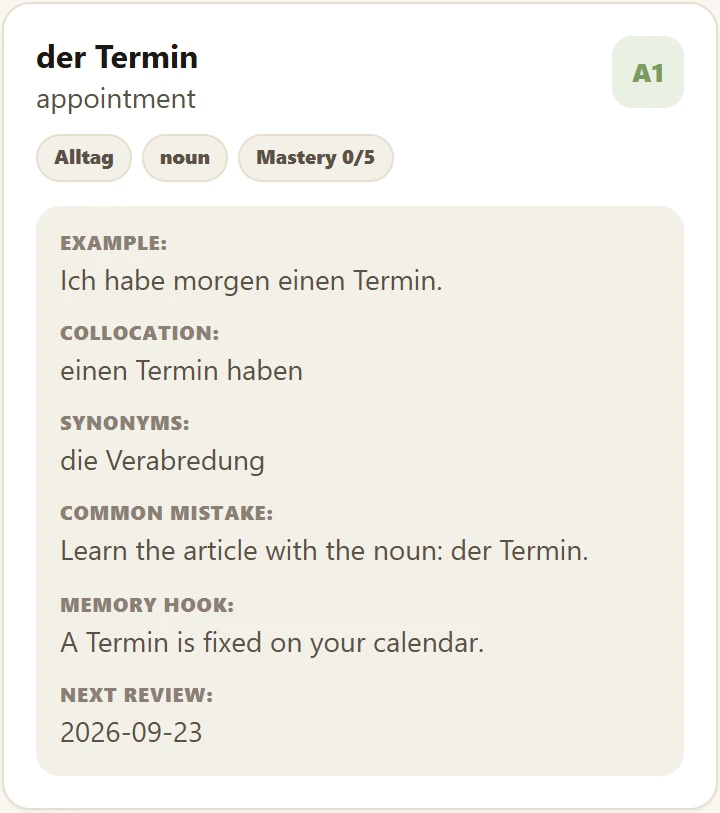
Turn a word card into a reply
The card keeps der Termin with a usable phrase: einen Termin haben. Hide the card, then say when your appointment is. Use the same retrieval step with the appointment exercise above.
English app interface.
Captured 23 September 2026; the interface may change.
Open the screenshot at full sizeExercise 2: build a reply with one sentence pattern
Use the pattern below to give a reason. Start with two short main clauses if the combined sentence is too much. The original examples are written for this guide.
Ich komme später. Ich arbeite bis sechs Uhr.
Ich komme später, weil ich bis sechs Uhr arbeite.
In this standard weil-clause, the conjugated verb arbeite comes at the end. Change the reason while keeping the rest of your message simple. Practise the sentence in response to a question, not only as a gap on a worksheet.
Someone asks: Warum kommst du später? Your train is delayed. Use: Mein Zug hat Verspätung.
Show one possible answer
Ich komme später, weil mein Zug Verspätung hat.
The conjugated verb hat moves to the end of the weil-clause. This written standard pattern is the focus here; spoken German also contains other constructions.
Lingeva app example
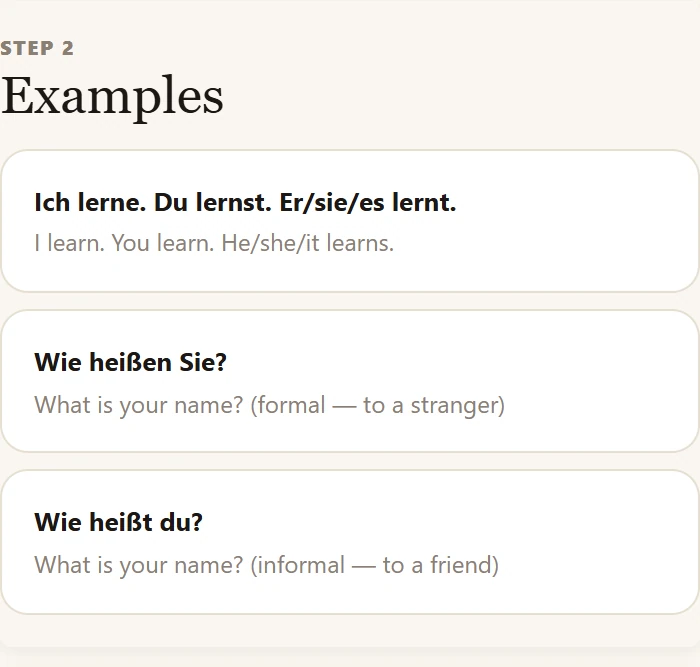
Notice what changes in the sentence
Compare Wie heißen Sie? with Wie heißt du? The person changes, so the verb form changes too. Use that same habit—notice the change, then speak the whole sentence—when you adapt a reply.
English app interface.
Captured 23 September 2026; the interface may change.
Open the screenshot at full sizeExercise 3: answer an unexpected follow-up
Now return to your colleague. You have suggested Thursday, but the answer is different from the one you prepared.
Donnerstag geht leider nicht. Können Sie am Freitag um zehn?
Check what changed: the day and the time. Answer that proposal. If you did not catch the time, ask for that part instead of pretending to understand.
| Your intention | German reply |
|---|---|
| Accept the new time. | Ja, Freitag um zehn passt mir. |
| Ask for one detail again. | Um wie viel Uhr bitte? |
| Check your understanding. | Habe ich Sie richtig verstanden: Freitag um zehn? |
You can meet on Friday, but only after eleven. Respond to the new proposal.
Show one possible answer
Freitag passt mir, aber erst ab elf Uhr. Geht das auch?
You have responded to the actual time conflict and invited an answer. A memorised introduction would not solve this turn.
Make the first real exchange manageable
Choose a small interaction with someone willing to talk: ask one practical question, confirm a detail or give a short answer. Prepare a way to ask for repetition. You can pause and restart a sentence; you do not have to demonstrate every rule you know.
Einen Moment bitte. Ich möchte den Satz noch einmal versuchen.
Afterward, write down one phrase you needed. Use it in your next exercise instead of listing every mistake. If speaking feels overwhelming, a supportive teacher can help adjust the task. This page does not explain or treat anxiety.
How do you know what to practise next?
- Did the reply convey the information you intended?
- Could you respond after a detail changed?
- Which word or structure did you need to look up?
- Did you ask for clarification when you needed it?
- If you spoke aloud, was the message understandable to a listener?
Keep the situation similar when comparing attempts, then try a new situation to check transfer. Completing this exercise is practice, not proof of fluency or an official language level. A typed reply alone cannot show pronunciation.
Should I wait until my grammar is perfect before speaking?
Use a pattern you already partly know in a manageable exchange. Review one error afterward. Keep studying grammar, but include a task that asks you to express your own meaning.
Can AI replace a conversation partner?
AI can provide prompts and a place to rehearse, but its corrections can be wrong. Human interaction adds the other person’s intentions, interruptions and feedback. Use both when possible.
Continue with the task you need
The written exercises on this page are public and require no account or microphone. In Lingeva, AI speaking requires Premium or eligible trial access, applicable permissions and available usage allowance. The app interface and explanations are in English and Vietnamese; German is the practice language.
Keep the connection going
Continue your German practice with Premium.
Use AI speaking and pronunciation practice, unlock B2–C1 learning, and prepare with Exam Prep A1–C1. Plan allowances apply.
Subscribe in the Lingeva iOS or Android app. Your store shows final prices, trial eligibility and renewal terms.